


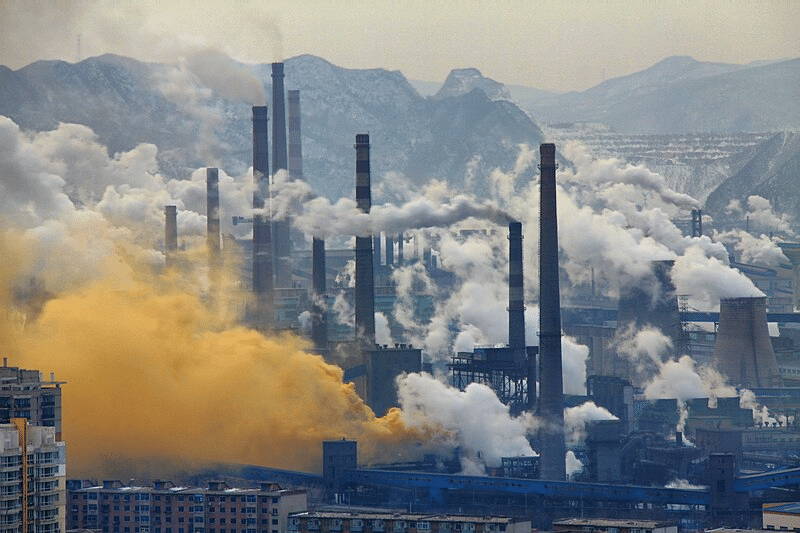
Benxi steel factory in Liaoning, China. Source: Energytracker.asia
This is the first post in a short series covering industry clusters. For more specific reading on China’s industrial strategies (which follows the questions laid out here), read Industry Clusters: How China Built the Machine.
Industry clusters emerge naturally over time.
Swiss watchmaking, Detroit automotive, East Asia electronics. The reasons why are abundant and mostly obvious: knowledge clusters and builds, experienced employees found new firms, supplier and buyer relationships form, infrastructure is tailored, transportation costs minimize.
Sometimes, when these clusters prove to be of vital importance, governments will encourage them to remain competitive, viable, and usually tied to one location, through a mix of subsidies, tariffs, zoning, regulation/deregulation, and education incentives. Occasionally, governments (usually more centrally planned ones) look to forge a new industry ecosystem from zero. However, in almost all cases, these emerge as self-organized systems.
These run on a spectrum from purely emergent to purely directed clustering, and I want to raise a fundamental question about what that means for clusters in 2026, specifically in China.
China’s economic rise since the days of Deng Xiaoping has been a hybrid case. Since winding down the Bǎinián Guóchǐ (Century of Humiliation) with the dawn of the PRC and reforms in the 1980s-90s, the country had identified widespread opportunity to become the factory of the world, or at least to experiment with export manufacturing as a lower-cost alternative to nearby countries who were quickly becoming wealthy.
Deng is the biggest figure here, but others, such as Xi Zhongxun in Guangzhou and Yuan Geng in Shenzhen, as well as Hong Kong industrialists, also deserve credit.
The upshot is that from 1984 to the 2010s, China effectively realized this opportunity.
The World’s Factory
Two megaregions dominate these clusters. For a quick shorthand-
Yangtze River Delta (Shanghai, Nanjing, Suzhou, Hangzhou): Automotive, machinery, chemicals, precision manufacturing, deeply embedded.
Pearl River Delta (Shenzhen, Guangzhou, Dongguan, Foshan, Hong Kong): Electronics, consumer goods, light manufacturing, fast, flexible.
There are also hyper-specific sub-city clusters with 1,000+ factories in essentially a large neighborhood. I’ve come across many of these in my time building manufacturing intelligence across Asia. Four examples:
Nanhai, Foshan, Guangdong - Aluminum processing
Ninghai, Ningbo, Zhejiang - Flashlights and lighting products
Daling, Dongguan, Guangdong - Knitwear
Shangyu, Shaoxing, Zhejiang - Umbrellas
Deng Xiaoping did not direct Ninghai to build flashlights. The array of products produced by China in the modern era is far too broad and ever-changing to be centrally planned- that’s an absurd premise and one that we’ll dig into when discussing the USSR in the next section. There is legitimate innovation (generally within established frameworks) coming out of China in ways impossible to fully plan.
What China did do was create the most robust and thorough incentives to enable industrial clustering- and the central government had unusual authority and breadth to do this. National, provincial, and city governments developed industrial parks and infrastructure, extended credit, built up land and technical institutes, and provided favorable subsidies, tax treatment, logistics, and industrial policy. This all happened to a degree to which we have generally not seen before and it happened within the framework of established global trade and product demand. The specific nature of these incentives and their unusual position in the modern world will be the focus of a sequel post following this.
That brings us to 2026, where China has, top-to-bottom, the most optimized industrial landscape across an enormous range of categories.
The concern, then, is whether China’s industrial ecosystems are too optimized and rigid to be flexible enough to respond to changes that the market will undoubtedly demand.
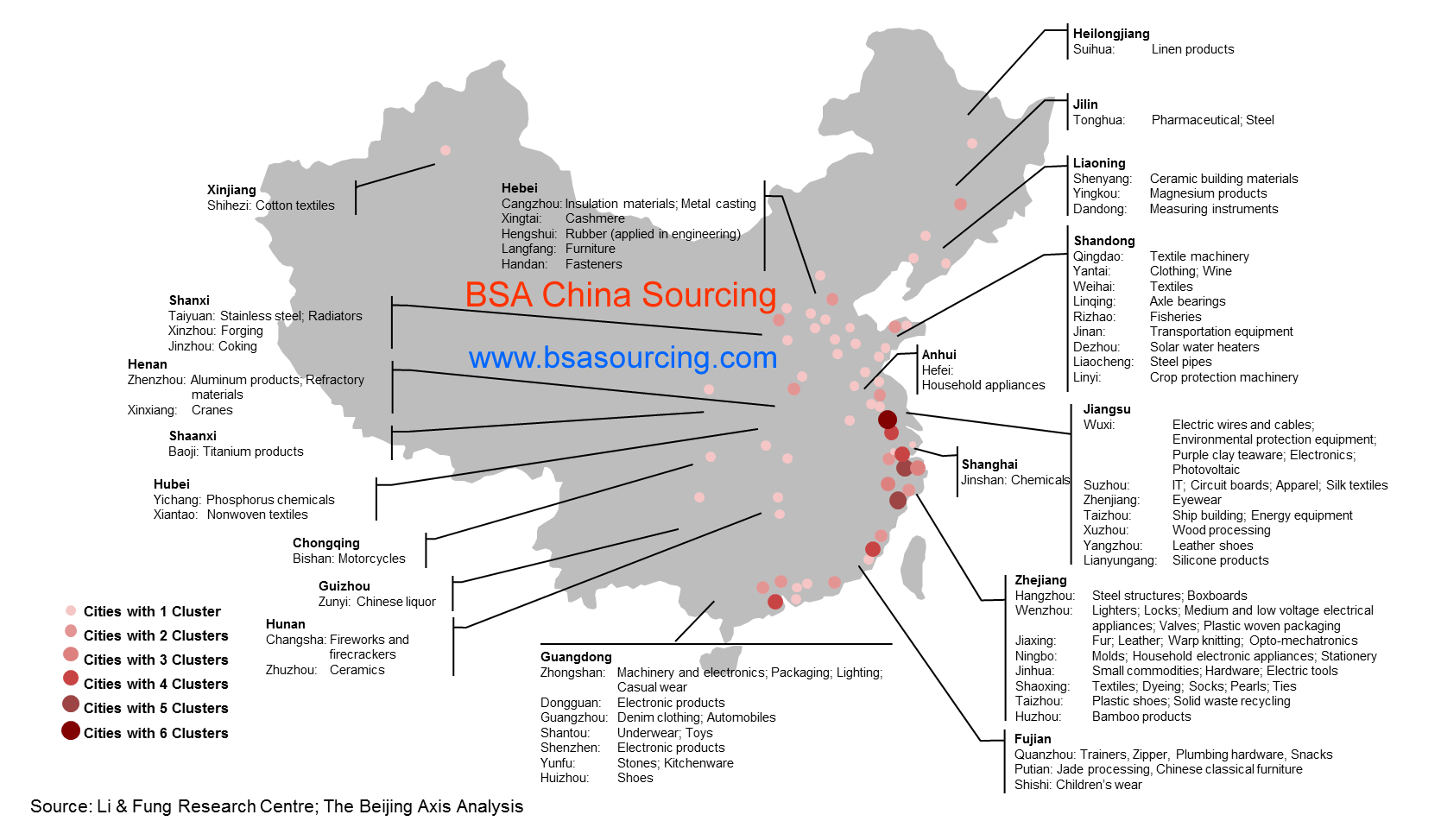
Industry cluster map of China. Source: BSA China Sourcing
A Few Points of Comparison
It’s worth highlighting a few other examples of historical industrial clusters and comparing them to China.
The Detroit auto industry essentially emerged on its own. The Great Lakes were used heavily for shipping ore and timber, and southeast Michigan had developed carriage/wagon manufacturing, marine engine industry, and metalworking. Henry Ford, William Durant, and a handful of others pushed things over the top. But critically, despite being naturally-emergent, the automotive industry here has been quite rigid, being Michigan and Midwest-focused and particularly in its engagement with unions.
Over time it has expanded out of Michigan and the Midwest, but much of that is the work of other car companies, not the Big 3 of GM, Ford, and Chrysler. As a native Michigander, I would argue that automotive industry inflexibility and Detroit’s inflexibility in adapting to changes (though they eventually adapted) are a defining example. Natural emergence does not equal adaptability.
The Ruhr in western Germany became an intensely productive region founded on top of coal deposits for iron and steel-working, that ultimately became a site for chemical manufacturing, heavy machinery, and more. It essentially began under Prussian rule and then within the German Empire, whose governments were heavily invested in development for both economic and strategic military purposes.
This region proved to be considerably more adaptable than Detroit, perhaps due to the early divergence of industry into a range of categories, and today is not known for heavy industry or metals nearly as much as chemical manufacturing and research universities. Consequently, the Ruhr is an example of the premise that state investment or development of a cluster does not make that cluster rigid. If anything, in contrast to Detroit, it could be argued that significant state involvement may have accelerated the Ruhr’s transition.
The USSR is much larger than either of the past two examples, but they represent the best example of nearly totally-directed industrial clustering. Driven by autarky and a need for total independence from the western world, Soviet leadership sought to industrialize an enormous country as rapidly as possible and also develop independent technology under time constraints. It goes without saying that much of this was also directed toward their military apparatus rather than meant to compete purely economically. Broadly speaking, the USSR’s approach was to develop an independent version of all technology, even if it was of lower quality than alternatives. Remnants of this still exist, such as Vostok Watches and Ural Motorcycles, viewed as quirky Russian products more than seriously pushing any technological envelope.
Selected for national strategic (not economic) reasons, the Ural Mountains became home to a handful of clusters: Magnitogorsk for steel, Chelyabinsk for machinery, Yekaterinburg for defense, and so on. The German invasion sparked a move of many factories from western locations into the Ural region, where they remained afterward. The fall of the Soviet Union led to a collapse of many of these industries, particularly those producing more refined goods, when competing on the global market- and this was not helped by extreme rigidity, and one of the least adaptable industrial ecosystems ever conceived.
Where China fits in this framework is a fascinating but emerging question. They have very clearly bypassed the obvious mistakes of the USSR, and may be able to take advantage of central organization to make swift changes. It’s worth noting that the framework I’ve established here is very simplistic and ignores many variables. 2026 moves at a very different speed than 1985.
How does this shape China’s future?
China has built one hell of a moat. US tariffs and pressure from lower-labor-cost alternatives in Vietnam, Thailand, Mexico, India, and elsewhere have not been enough to unseat or even move China’s position. But what happens if the moat becomes a constraint?
Nearly every Chinese industrialist treats Vietnam and Thailand like a dangerous strategic salient, one that’s only extended into as far as necessary before pulling lines back into China for as many processes as possible. China is safer- companies are surrounded by a network of partners they know, logistics they can rely on, and quality they’re comfortable with.
But will it be this way forever? Labor costs have quadrupled in the last decade in key manufacturing cities. Although Vietnam is often more expensive right now (due to a mix of logistics costs and inefficiencies), as quality inevitably rises, it will become a strategic hub for certain categories. This is well underway, and Vietnam is joined by Thailand, Malaysia, Mexico, and other countries.
China has ways to offset this. Automation was covered in a previous post. Direct foreign investment has proven to be an excellent vehicle for expanding influence and options. China has also shown enormous adaptability in the past, but that was when the entire country was essentially treated as a greenfield development- not the case any longer. There are trade-offs to be made in every consequential decision in 2026.
More plainly, in 2000 it was easy to convince a farmer to make 10x wages by moving from rural Anhui to Changzhou and work in an auto plant (and to provide the training).
In 2030, if half a factory’s processes are not economically viable and must be done elsewhere, it raises some questions.
Do you begin to disassemble a cluster?
Does the remaining city stagnate economically? How do local politics play into this?
What happens to employees in that region?
Does it become tangled with other industries geographically or in terms of employee crossover? How much downtime is there in retraining employees?
Most importantly, who makes these decisions and how much bandwidth do they have to solve the problem?
These are all novel questions for China. I’m sure they have answers, but the reality will be messy.
