

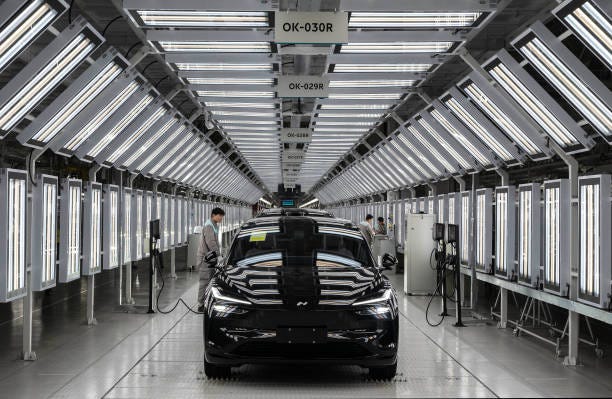
NIO’s auto factory in Hefei, Anhui, PRC. Source: Getty Images
This post is a standalone sequel to my previous post discussing industry clusters more generally, with some historical examples (Industry Clusters: Optimization vs Adaptability). Suggested but not required reading.
Note: Many of the sources for this article are in Chinese and were translated using Microsoft Translate.
How did China’s industrial ecosystem get to be so potent, and how will it evolve in the future?
In my previous post, I established that industry clusters generally emerge on their own, but they are supported and protected by governments (at all levels), and occasionally set up originally in a planned manner. Although China has built the most sophisticated industrial ecosystem the world has ever seen, via a mix of unplanned and planned clusters, I want to dig deeper into whether there are trade-offs in terms of future adaptability.
We will look to answer five questions:
What does one of China’s unplanned clusters look like? What strategies and incentives did China use to support it?
What about one of its planned ones?
Is there a rivalry between provinces or cities in China to win business? How are these resolved, and what do they look like?
What happens when one of China’s industry clusters starts to dissolve or migrate elsewhere? (And what is the root cause?)
What are the implications of all of this for China’s future?
Let’s begin by discussing Yiwu, a cluster that emerged on its own.
Yiwu: The Unplanned Cluster
Note: Yiwu is the namesake of the Yiwu Index, which I covered in a past post about Christmas trends in the West.
Located in central Zhejiang in a beautiful green mountain valley, Yiwu is placed quite ideally in close proximity to port cities like Shanghai and Ningbo, but is far enough away that it was a good early base for production. It started out quite poor and had no land for agriculture and consequently had to build up a strong commercial tradition. Yiwu began as a trading cluster.
Follow Deng’s reforms, in 1982, local CCP secretary Xie Gaohua essentially reactivated this commercial tradition that had been dormant for a generation, organizing a small-commodities market with 700 stalls. The local government used several incentives to reinforce the early success:
Legalize and protect merchants. In 1982, Yiwu adopted “Four Permissions”, allowing farmers to trade and engage in long-distance commerce. This brought outside traders in.
Build and expand infrastructure. Local government created the Huqingmen market, and enlarged and relocated it as needed (taking out a 570k RMB bank loan to expand by 1.5x in 1983). Transport infrastructure was added over time.
Simplify taxation. Initially, Yiwu used a complex progressive tax system, but replaced it early on with a simple fixed-quota system based on stall location and merchandise type. Overall collected tax rose early on.
Adopt formal industrial policy. In 1984, the county adopted xing shang jian xian as its central economic development policy (literally “build the county through flourishing commerce”). In the 1990s, this changed again to more specifically include manufacturing incentives. The ultimate model is now self-described as “small wares, big industry; small enterprises, mega cluster”.
What came after this was a feedback loop: traders knew what was selling, and nearby producers sprung up, who could react to or anticipate changes. Suppliers followed. Yiwu developed a manufacturing focus in smaller household goods: toys, decorations, and small textiles.
Yiwu is a prime example of a naturally-emerging cluster that was not designed or planned. It had the history, the geography, and importantly, lacked more economically productive industries early on. It’s probably fair to characterize most early Chinese manufacturing, and most less-strategic manufacturing, as following this model. In the early 2000s, when “Made in China” came with baggage in the West, and when it was mostly associated with cheap consumer goods, these self-organizing clusters were responsible more often than not.
Hefei: The Bet That Paid Off
Hefei is located just west of Jiangsu and Zhejiang, as the capital of Anhui province. It has some wealthy areas but historically was something of a hinterland or relatively normal provincial capital beyond the core Yangtze River Delta region. Its development was much more recent and tech-forward.
Hefei’s largest strength into the 2000s was its University of Science and Technology of China (top 10 nationally). Around this time, as China’s economy had been growing substantially, Hefei made a conscious decision to go after higher-tech industry, using the university as its anchor. BOE Technology was looking for a home to manufacture China’s first 6th-generation TFT-LCD screen line, but had huge capital requirements. Hefei welcomed them, with the local government committing 6 billion RMB and helping to arrange the remaining financing and infrastructure. This was just the beginning.
What’s important to note is that Beijing had very little, if any, role in this. This 2008 agreement (early in China’s pivot toward tech) was signed between BOE and Hefei’s municipal government (and two of their investment organizations). National-level entities and policies were involved, such as the China Development Bank. Therefore, far from designing Anhui’s economy, Beijing built the framework and conditions for more regional and local bets to be made. This was never guaranteed to work, by the way, but it did in this case, and Hefei continued to make larger bets.
Hefei next went after semiconductors, bringing DRAM producer ChangXin Memory Technologies to the city. However, the larger story is EVs: Amid a very competitive domestic market in 2020, manufacturer NIO was falling behind, burning cash, and losing the product race. Hefei and state-backed investors agreed to invest 7 billion RMB into NIO, and consequently, NIO agreed to relocate their headquarters to the city, along with R&D, manufacturing, supply chain, and sales functions. By this point, Hefei had acquired multiple tech-focused anchor industries.
In 2026, NIO is in a better position; the move effectively saved it from dissolution, but it continues to have challenges around profitability. There are other questions around the EV industry across China as a whole. This isn’t a clean win across-the-board, but Hefei, in 18 years, has achieved much of its original goals architected by local CCP secretary Sun Jinlong. Hefei is now home to a much broader tech ecosystem around EVs, displays, and DRAM, as well as adjacent industries. Bear in mind, this is the 15th-largest city in China with 4.9 million people. Tier-1, but probably not known to most foreigners. It’s a very utilitarian, pragmatic success story.
The principal takeaway here is that while more recent industrial and economic success within China more designed than self-emerging, it’s a country mile from the top-down Beijing-centric command economy that most Westerners hold over from a much earlier and less sophisticated era. That said, the situation isn’t without complexity. The EV industry has its challenges, there are major hurdles with economic deflation, and it’s especially interesting to consider what happens if another city is competing with Hefei to acquire a particular industry cluster.
Interprovincial-Intercity Rivalries for Industry Clusters
China’s economic structure in the Xi era is hierarchical, decentralized, and competitive. From 2000-2022, subnational governments produced a large majority of the 770,000 industrial policy papers across China. That’s actually pretty striking to consider. Beijing provides the structure, but inside of it, provinces, cities, companies, and individuals compete- profit and prestige are the prize. Sound familiar?
The prestige component is important. Outsiders can pretty easily grasp profit incentive, but the CCP has typically operated a model in which high-potential officials are given assignments in provincial capitals and assessed by their performance. This turns into a tournament and can produce tribalism to companies and institutions in a given province. EVs are a perfect example, because especially in the 2010s, they were a strategic industry and national priority, but again, Beijing did not designate one city or province as China’s EV HQ. Instead, separate regional clusters formed. Beijing has Xiaomi and Li Auto, the Yangtze has Geely, NIO, and Leapmotor, and the Pearl River Delta has BYD, XPeng, and GAC, while there are others in Guangxi and Chongqing.
There are upsides and downsides to this model. China has recognized that competition is healthy and produces innovation and drives the EV industry (and of course others) forward. This is central to being product-competitive globally, and these brands of course now very much are. The drawback is naturally that the country is organized with competing rather than complementary clusters, in some cases, with the YRD and PRD functioning as independent factory ecosystems, competing just as they each are competing with Korea or Taiwan in certain categories.
In the modern Chinese model of what has been called state-backed capitalism, this inter-city rivalry is as close as the country gets to pure market selection (and there is already substantial overlap with how strategic industries are distributed in the US, for example).
The downsides extend a bit further. Once an industry becomes fashionable (EVs, battery cells, consumer electronics, solar, semiconductors), each province wants skin in the game, and not just to be a supporting actor. This can be lead to regional governments subsidizing their local champion. Recent industrial policy research (Stanford Center on China’s Economy and Institution) indicates that imitators and lagging cities support particularly weak entries into a given industry. Not all Chinese companies and clusters are equal.
There are other oddities, and this one will surprise no one who has spent time in China: clusters tend to draw industry fragments to the edge of borders of poorer provinces neighboring richer provinces. Because a province is a nationally established entity with designated funding, there are geographic anomalies we would not generally see in the West. We can see numerous examples of this. Wander just outside of China and you’ll see Hong Kong’s north is extraordinarily rural farmland. Just across a small river, you have the dense urban core of Shenzhen. This is a dated example. But if we return to Anhui, you have suppliers and upstream support industries built up on the periphery where the province touches wealthier Zhejiang and particularly Jiangsu- but they are not located in Zhejiang and Jiangsu, in large part because they were subsidized to be in Anhui.
Fundamentally, this competition has drawbacks, but creates a robust internal market for industry clusters within China, letting some form of invisible hand move industry clusters into somewhat more settled positions within the broad framework than they would if guided purely from Beijing. And as we’ll see, these clusters do move.
Dongguan: The Dissolution of a Cluster
Dongguan is right in the heart of the Pearl River Delta region of Guangdong province. Neither a historic metropolis like Guangzhou or an urban tech hub like Shenzhen, Dongguan has been an in-between catch-all that has included a range of industries and evolved substantially over time. It’s one of the largest cities in China but is better pictured as a corridor of towns that have grown together.
To be clear, cluster movement and dissolution in China’s past has been complex, and is probably not a great indicator of what it may look like in the future, because their economy has accelerated quickly up to this point and is now stabilizing and settling into key future-oriented industries. From here, there isn’t an obvious next step to progress to, which creates uncertainty if industries leave for any reason.
Dongguan has always been a convenient relatively lower cost manufacturing area within the Pearl River Delta. From 2000-2010, it was a hotbed for furniture and footwear manufacturing. Things changed quickly from there. The PRD in general and Shenzhen in particular were moving upmarket quickly, and electronics production was on the horizon. Most of Dongguan’s existing manufacturing left for inland cities that were much lower cost (and eventually Vietnam and other countries). Dongguan inherited firms moving from Shenzhen. Foxconn, BYD, Huawei among the biggest, but only the tip of the iceberg. By 2014, Dongguan launched a formal “Machine Replacement” program to subsidize automation efforts.
What fundamentally drove this is more productive opportunities opening up in Shenzhen. Real estate, which as of time of writing in Shenzhen is among the highest in the world relative to income, had to be used for more productive purposes. Shenzhen moved into high-tech R&D, advanced manufacturing, design, HQ, software, and other advanced tech. The middle-manufacturing layer and facilities with large footprints went north.
What is more fascinating is what happened to people in Dongguan who worked in these factories that were relocating. Perhaps bucking expectations, these employees (many of whom were not originally from Dongguan and had moved there for work) relocated rather than upskilling. Dongguan’s migrant population fell from 5.5M in 2008 to 4.3M in 2016, with large declines among migrants from Sichuan and Hunan. This doesn’t sound substantial, but it is surprising given the level of growth in this region. Likely, many of these people returned to home provinces or new provinces with more work.
Running contrary to this, Dongguan actually saw a population increase from 8.2M in 2010 to 10.5M in 2020. The city added vocational programs and training around newer manufacturing methods and products. What this seems to indicate is that to some degree, these were different people with different skills moving with industries that they knew. If these workers could not find work as factories went overseas, it seems that they found other options but were likely underemployed.
I spend a lot of time working in Dongguan, and I’ll be the first to tell you that there is still shoe production there- and a lot of remnants of it, large factories shaped like giant shoes, residual Italians who stuck around and married a local and run fantastic restaurants, leather markets selling high-quality goods for cheap. This hasn’t been clean, it’s a lot messier than I described in 7 paragraphs: Dongguan metabolized new industries and moved largely upmarket, but not everyone moved upmarket with it.
What does this mean for the future?
As I alluded to before, it’s hard to characterize China’s future in terms of its past- recent or ancient. This is because the rate of change has plateaued considerably and China is now operating at or near the technological and industrial frontier.
I would estimate that the biggest changes will occur in more inland provinces, ones we’ve barely discussed here. The most likely and obvious projection is that China’s rural interior will move into mid-tech industry and the standard of living will rise gradually. It’s likely that existing, more entry-level manufacturing will be displaced and migrate to Southeast Asia and elsewhere. This is a bit of a lagging projection, as much of this has already happened throughout China.
The Pearl River Delta and Yangtze River Delta will remain the biggest and most important clusters, but may stay much like they are now for a long time. Some of the supplier-level industries, which support higher value-add industries that will remain in these clusters, will likely be pushed to other regions. My prediction is that a 2050 China will contain 2-4 “Taiwan islands” full of wealthy high-tech manufacturing, surrounded by agriculture and tourism.
However, from what we established in this post, industrial clusters seem to rarely disappear outright. They fragment, with production moving first, design and sales later. Supplier following, splitting operations, or dying off. Workers scatter, and the city adapts as best it can to what comes next, which complicates any clean story about the future.
Truthfully, there are too many major variables in this enormous country to predict its future with much accuracy. Below, perhaps the subject of future discussion, are what I consider to be the biggest factors to be aware of.
Xi Jinping’s long-term succession. Probably the biggest single variable that will have outsized impact on everything, maybe even globally.
Demographics - age structure, not population decline. China needs to rebalance and find stability with more working-aged people.
Economic engine - changing from infrastructure investment to productivity/consumption. Find a way to build a robust consumer economy.
Local government-level finance, property, and debt. This post shined a light on the local layer of government, but didn’t touch on how tied it is to property development, and the many issues with debt at this level.
Infrastructure was all built at the same time so it will all age at the same time. Lots of maintenance ahead. Is maintaining the country as exciting to the next generation as building it was to this one?
Frontier innovation. China is exceedingly good at industrialized innovation, inside of identified strategic domains. Frontier innovation relies on getting a bunch of unusual people together and seeing what happens, often spending enormous sums of money for nothing to come of it. Can Beijing make this happen?
State-private sector balance. Innovation relies on unpredictability. Governments want predictability.
If we layer these variables on top of China’s sophisticated and enormous industrial machine, there are many possible futures. As impressive as the run from 1978 to 2026 has been, what lies ahead will likely make it look easy by comparison.