


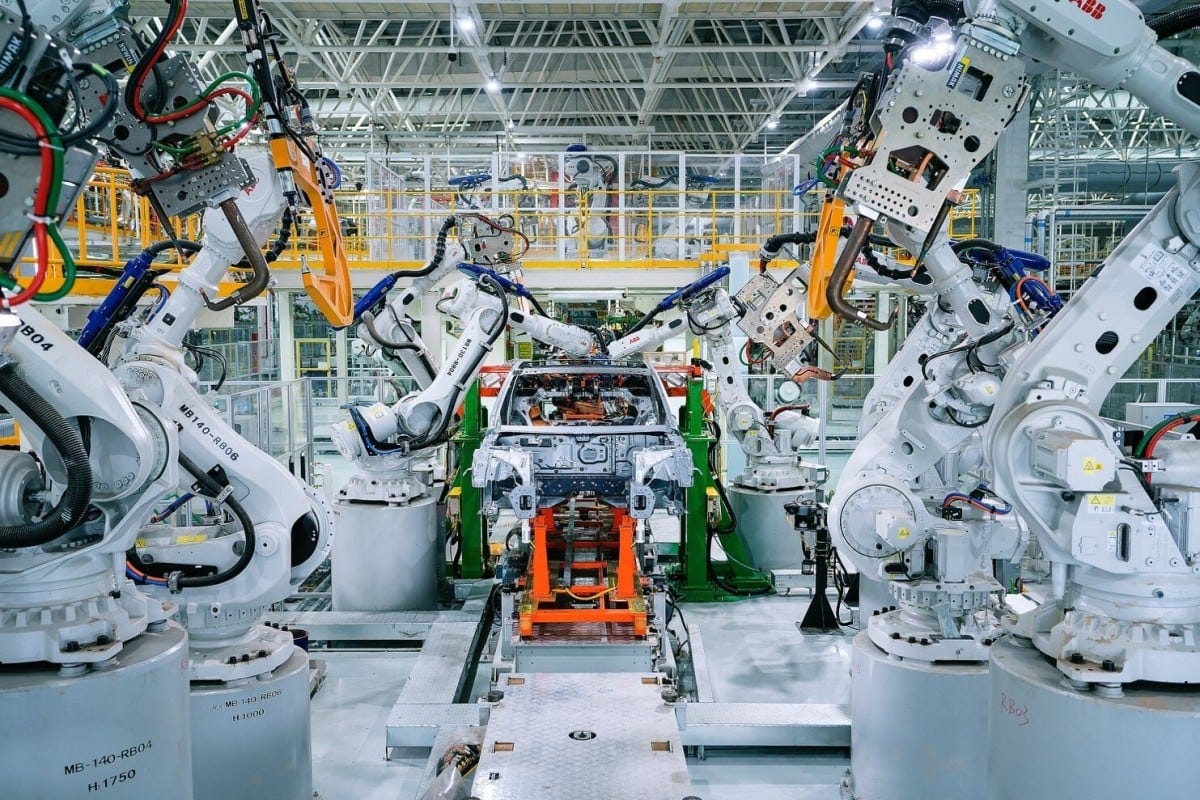
XPeng’s factory in Zhaoqing. The leading electric vehicle manufacturer has invested heavily in automation. Source: South China Morning Post
For a deeper read on China’s industry clusters that employ this automation, look at Industry Clusters: How China Built the Machine.
For the last twenty years, the West’s mentality toward China has been simple (and initially, accurate): Cheap labor. Endless factories. Container ships stacked with low-cost goods heading toward Los Angeles and Rotterdam.
The reality began shifting 15 years ago and this perspective is completely obsolete in 2026.
China’s economy is not collapsing, and it is not standing still. It is changing shape, and the transformation is happening in the most important place an industrial economy can change, the factory floor.
If you take nothing else away from this post, note that in 2024-25, China was responsible for 54% of the world’s industrial robotics installation, a rate about 10x as high as the US.
The Robot Surge
In the past decade, China has quietly become the largest adopter and implementer of industrial robots on Earth. According to the International Federation of Robotics, roughly half of all new industrial robots installed each year now go into Chinese factories. In several recent years, China installed more robots than the United States, Japan, Germany, and South Korea combined.
This statistic tends to surprise people in the United States because it clashes with a deeply ingrained image of China as a place defined primarily by cheap labor. That image was always incomplete, but today it is actively misleading.
The story of Chinese manufacturing is no longer one of vast armies of low-wage workers assembling products for export. Increasingly, it is a story about automated production lines, machine vision systems, and robotic factory cells running 24 hours a day.
Far from abandoning manufacturing, China is simply upgrading.
The End of the Cheap Labor Era
For roughly 40 years, China’s growth followed a powerful but relatively simple formula.
Hundreds of millions of workers moved from rural areas into coastal production cities like Shenzhen, finding jobs in factories for all kinds of goods- initially textiles and domestic products, then electronics. Exports surged, infrastructure expanded, and the country became the hub for global manufacturing.
However, the conditions that made this possible have changed:
China’s working-age population has begun to shrink.
Wages in the country’s coastal manufacturing hubs have risen dramatically compared with the early 2000s (anecdotally quadrupling in the Guangzhou-Dongguan-Shenzhen area in the past decade alone).
At the same time, the massive property sector that once drove domestic growth has become a drag on the broader economy.
These pressures are forcing a transition.
Rather than relying on endless labor supply and real estate expansion, China is trying to push its economy toward higher productivity, more advanced manufacturing, and greater technological self-reliance. Automation is central to that effort. Robots allow factories to maintain output even as labor becomes scarcer and more expensive. More importantly, automation raises the ceiling on what those factories can produce.
The country that once dominated global manufacturing through scale is now attempting to dominate it through technology.
A brief aside: It’s important for westerners to realize that there are basically two versions of China. Urban professionals in China make around ¥150,000 annually, while workers in rural China make closer to ¥50,000 annually (USD $1 = CNY ¥6.90 in March 2026). This is reflected in per-capita GDP varying wildly by province, such as USD $7k in rural Gansu versus $35k in Beijing and $25k in Jiangsu province (north of Shanghai). These differences are more significant than than what we see in California ($102k) versus Alabama ($39k) in the US.
Not Collapse, But Maturation
Many Western analysts, including commentators like Peter Zeihan, have argued that China faces an inevitable economic collapse driven by demographics, debt, and political rigidity.
There is truth embedded in those concerns. China’s demographic outlook is difficult, its debt levels are high, and the unwinding of the property sector will likely weigh on growth for years, but decline and collapse are not the same thing- and necessary reinvention builds a robust future.
A China growing at four percent annually while rapidly expanding automation, energy production, and advanced manufacturing capacity is not a collapsing economy, it’s a maturing one. Expansion slows, but industrial sophistication becomes a deadly economic tool on its own.
In fact, many of the industries driving China’s next phase are precisely the ones expected to define the global industrial economy over the coming decades. Electric vehicles, battery manufacturing, solar energy systems, industrial robotics, and advanced manufacturing tools are all areas where China has built enormous scale.
China is no longer competing on cost, they’re competing at the technological frontier of manufacturing.
The U.S.–China Paradox
This transformation is unfolding against the backdrop of one of the strangest geopolitical relationships in history. To state the obvious, the US and China have both an unprecedented economic partnership and somewhat unprecedented strategic rivalry. Can you imagine if the Soviet-US relationship was just as distrustful but also totally economically linked?
American companies remain deeply embedded in Chinese manufacturing ecosystems, relying on dense supplier networks that took decades to build. Yet Washington is increasingly attempting to reduce dependence on China through tariffs, export controls, and industrial policy.
The semiconductor sector sits at the center of this struggle. Companies like Taiwan Semiconductor Manufacturing Company and Nvidia represent critical nodes in the global computing infrastructure that both countries rely upon.
The United States is trying to restrict China’s access to the most advanced chips and manufacturing equipment. China, in turn, is investing heavily in domestic capabilities while simultaneously pushing forward in other parts of the industrial stack.
Automation sits right in the middle of this contest. The more automated China’s factories become, the less vulnerable the country is to labor shortages or rising wages. At the same time, a highly automated manufacturing ecosystem is extremely difficult to replicate elsewhere, because it depends on deep supplier networks, specialized equipment, and years of accumulated industrial knowledge.
The Question That Matters
Much of the public debate about China’s future revolves around GDP rankings. Commentators argue about whether China will surpass the United States as the world’s largest economy (outright, not PPP), or whether its growth rate will fall to three percent, but these debates miss the deeper shift now underway.
The real question for the next decade is not which country grows slightly faster in any given year. It is which country controls the automated industrial base of the twenty-first century.
The nation that dominates robotics, batteries, power electronics, and advanced manufacturing will shape the physical infrastructure of the global economy. These systems determine where products are built, how quickly supply chains adapt, and which countries maintain industrial leverage in times of crisis.
China appears to understand this very clearly.
Whether its strategy ultimately succeeds is uncertain. Demographics, debt, and geopolitics will continue to complicate the path forward.
But one thing is already visible on factory floors across the country: China’s next great leap forward will not be powered by cheap labor, it will be powered by robots.
