


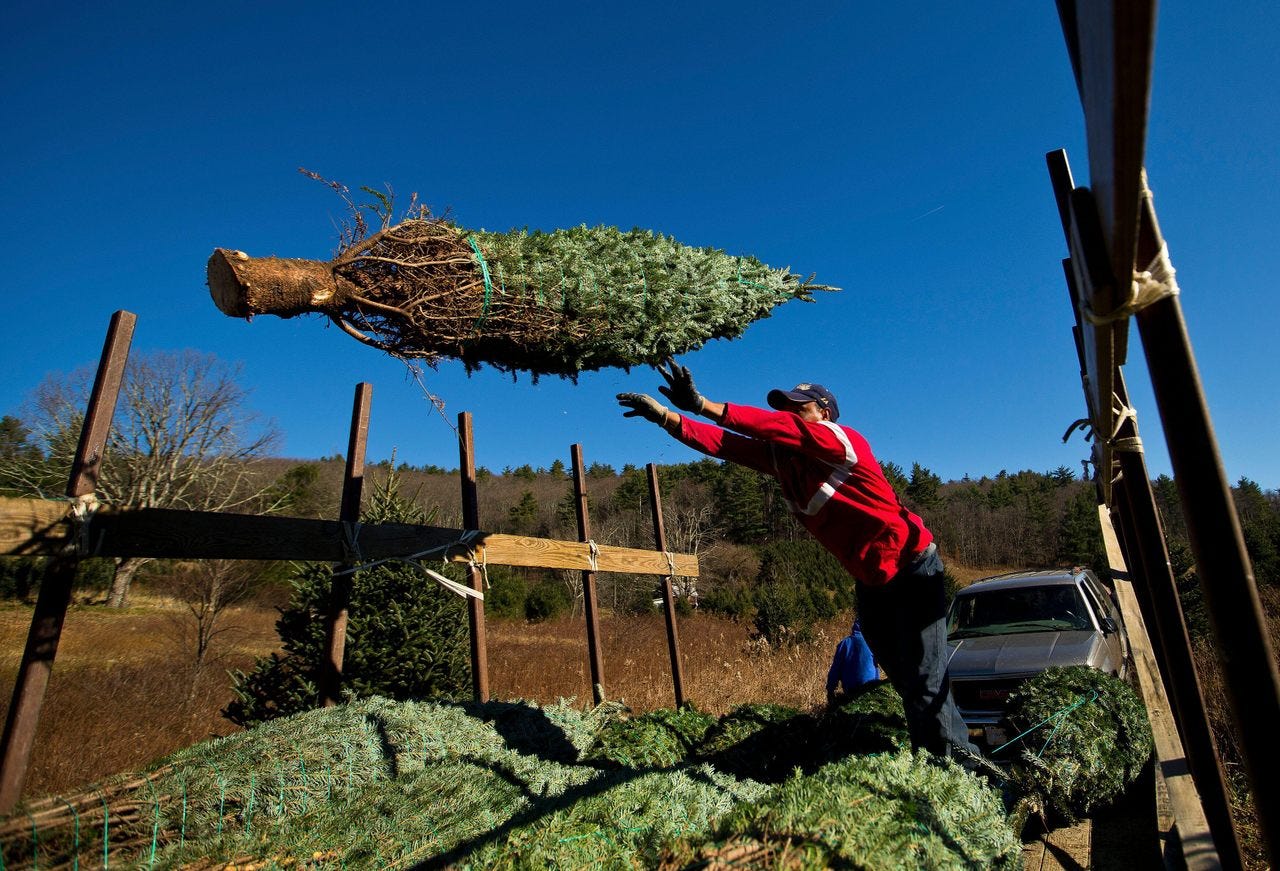
Christmas trees being baled and loaded at Omni Farms in West Jefferson, NC. Source: Chris Keane/REUTERS/Alamy/Atlas Obscura.
I’m in Shenzhen today (a few weeks before Christmas, at time of writing), in the Nantou Ancient City district. This place is as lively as I’d expect for China’s third largest city any time of the year. But today, with bursts of red and green, faux-snow-covered Christmas trees, and Santa and Rudolph ornaments for sale in every third shop, it feels even busier and more jovial.
I’m surprised by this. Mainland China doesn’t strike me as a place to celebrate Christmas, and there are essentially zero foreigners here today. Traveling with me, my Hong Kong friend seems to read my mind and interjects that Chinese people look for any reason to celebrate and shop- Christmas just fits the bill for December. I’m not entirely convinced, as shops are going above and beyond with the decor, but that’s beside the point.
She muses about the evolution of the holiday in China, and as she reflects on her Christmas traditions over the course of her life in Asia, my mind naturally starts to map out the surprisingly complex supply chain of Christmas. It’s my first December living abroad, and I’ve uncovered two surprising Yuletide connections between the US and China, revolving around two tiny but high-impact towns.
Oregon’s Christmas Trees
Christmas trees are everywhere in Hong Kong right now- there’s a big one in front of the Mandarin Oriental Hotel in Central that I’ve passed a dozen times, assuming it and the many like it came from a forest up in Hunan or Guangdong. I couldn’t be more wrong. My friend informs me that every year, she would order her tree from a local retailer selling them directly from Oregon. That’s 10,600 km away.
This little fact shocked me, especially because of the obvious- trees are alive, and cross-Pacific freighter trips take 2 weeks. The answer is apparently refrigerated containers, which help preserve freshness substantially.
Sitting on the edge of Oregon’s Willamette Valley, the town of Estacada (pop. 5,000) has quietly become a global powerhouse and was designated the “Christmas Tree Capital of the World”. The town and region happen to have perfect growing conditions, long-standing family farms, and export infrastructure that allows thousands of trees to move through cold chain without losing freshness.
Most years, the global Christmas tree market breaks down roughly like this: the United States and Canada dominate production of natural firs, Europe relies heavily on Denmark and Germany, and Asia imports nearly all of its real trees from North America. Within the US, Oregon and North Carolina are the giants (my home state of Michigan coming in third, as of 2022), with Oregon leading by volume thanks to its enormous Douglas fir and Noble fir output. The trees often take seven to ten years to mature, and because the harvest cycles are predictable, farms can plan around global demand.
This creates a small but fascinating seasonal artery: Oregon farmland to Hong Kong port terminals, onward to flower markets and apartment lobbies. It’s a reminder that even something as nostalgic as the scent of a pine tree is occasionally a product of cross-Pacific logistics.
For those curious, this HK-based retailer is selling Oregon-sourced Noble firs for USD $280-612 depending on tree size.
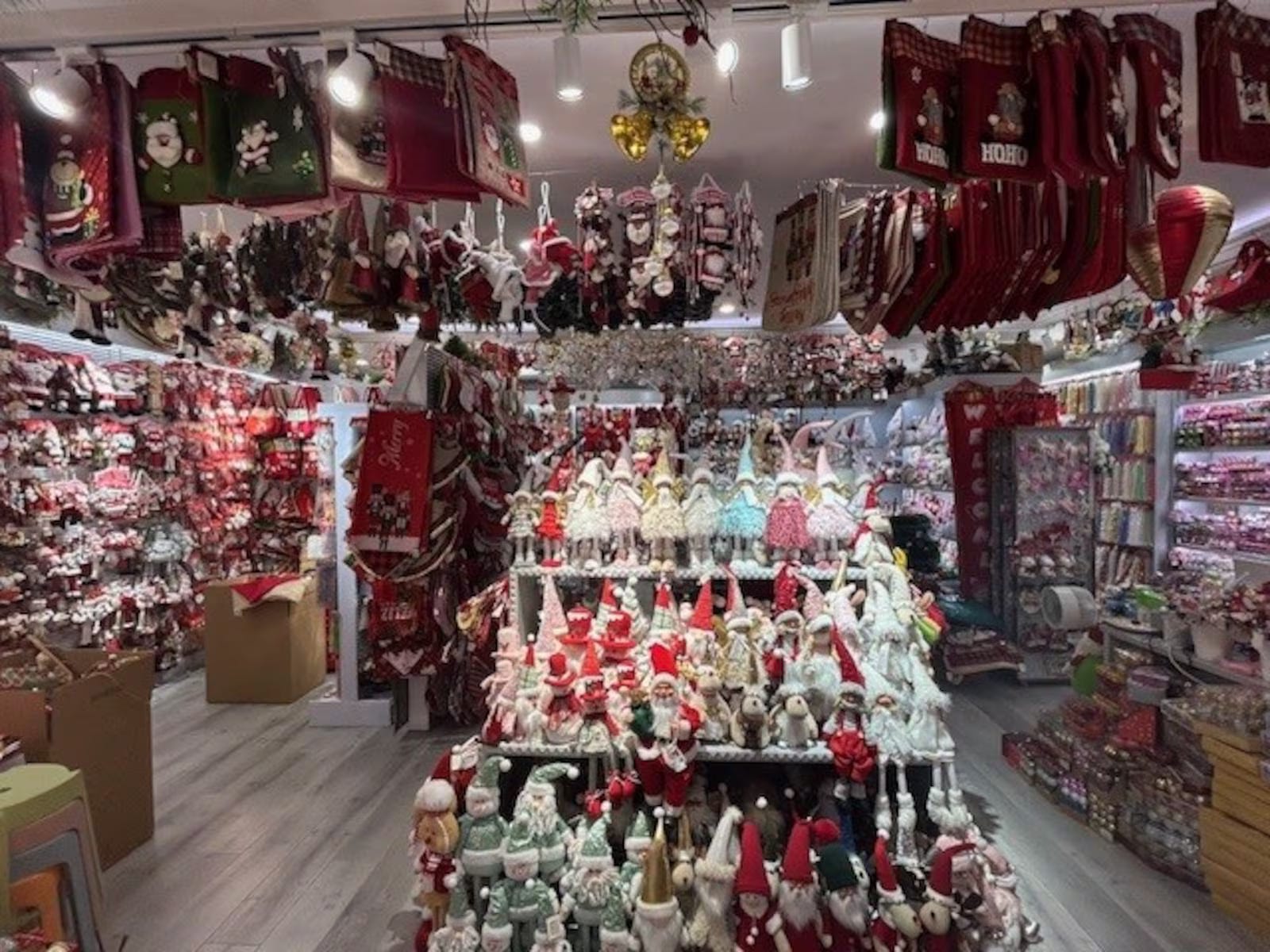
Christmas decorations in Yiwu, China. Image credit: Denis Staunton/The Irish Times.
Yiwu, the City That Predicts Christmas Trends
Note: Yiwu is a fascinating city with a rich commercial history and contributions beyond the scope of this post. To read more, check out Industry Clusters: How China Built the Machine.
Opposite the ocean from Oregon and a ways north of Hong Kong is another comparatively small city: Yiwu, in Zhejiang province, population a mere 1.86 million. At face value, a smaller manufacturing hub a few hours south of Shanghai is not cause for any special attention. But Yiwu is different.
A few weeks ago, another good friend explained to me that this otherwise un-noteworthy city has predictive powers. The actual practicality of the “Yiwu Index” is heavily debated, but many believe that because the city is home to manufacturers of a wide range of household goods and novelty items, quick surges in demand for certain specific goods might predict political and economic trends (i.e. a big uptick in yellow vests pointed to an increase in protests in France circa 2018).
Walking through markets in Yiwu, Christmas unfolds six months before anyone in the West thinks about it. If Americans suddenly want pastel ornaments, metallic garlands, or inflatable Santas with LEDs, this city knows first. Orders flow in long before retailers publish trend reports, and the assembly lines become an early indicator of where US holiday taste is drifting.
Factories here don’t just make Christmas goods. They act like cultural sensors. They absorb demand signals months ahead of time and convert them into millions of units. It’s a strange quiet power. Workers who have never been to the US can tell you what the “hot color palette” will be that year by watching what Western buyers request in July. Yiwu exported $244M of Christmas goods globally this year. Apparently, sustainability and modular decor is big in 2025, particularly items that can be used from Halloween through the Christmas season (possibly like adding Santa hats to those 12-foot skeletons?).
If Oregon exports the feeling of Christmas, Yiwu exports the look of it. Between them, a holiday aesthetic travels the world long before people put lights on their houses.
I like these little stories because they’re great examples of supply chains in our everyday life, and some of the strange complexity that delivers otherwise completely normal products to our homes. It’s not all about semiconductors and frontier tech- sometimes it’s nice to appreciate how a couple of out-of-the-way cities and towns an ocean apart both have unexpected impact on Christmas for people the world over. A forest in Oregon makes a Hong Kong living room smell like Christmas. A cluster of workshops in Yiwu decides which ornaments end up on a tree in Milwaukee.
As the year winds down, I’m wishing all Hidden Layer readers a Merry Christmas and an enjoyable time with your families. Cheers.
