


I used to rule my world from a payphone, ships out on the sea. Now times are rough and I got too much stuff.
Jimmy Buffett, One Particular Harbour
UPDATE: Check progress on the Nomad project at Hidden Layer Labs.
For the past couple years, I’ve spent a large portion of my time moving between Hong Kong, mainland China, and supplier locations scattered across Asia. Most of this work happens in ordinary places- hotel rooms, factory offices, airport lounges, the back seat of vans heading to industrial parks on the outskirts of cities I hadn’t heard of a week earlier.
This kind of travel exposes a strange truth about modern work: almost everything we do depends on infrastructure that we don’t control.
My phone is everything. Payments, navigation, communication, boarding passes, and authentication. Some documents are stored locally on my laptop, but year after year, more storage migrates to “the cloud”. What is the cloud? A computer the size of a warehouse in Iowa owned by Sergey Brin and Larry Page. In other words, your digital life depends on a stack of networks owned by airlines, telecom, hotels, governments, and big tech.
95% of the time, this works just fine, but when it fails, the failures cascade.
I’ve started noticing that virtually every problem I encountered while traveling could be traced back to three things: power (electricity), cellular data, and access to money. If these three systems work, I can usually solve everything else. If one fails, I can usually recover, but if two fail simultaneously, things start to get hairy.
Confronted with this reality, I started building my travel system accordingly; more resilient infrastructure stack than packing list.
Philosophy for Travel Infrastructure
I now pack according to a few simple rules:
Prioritize power, cellular data, and access to money.
Remove single points of failure for those systems.
Maintain an analog fallback whenever possible.
Standardize everything on USB-C, without exception.
Where possible, standardize accounts and systems (I use Apple (hardware), Google (apps), Peak Design bags, and Anker electronics systems across the board).
Don’t check bags.
If in a cash country, carry about ten beers worth of local currency. It sucks being thirsty.
This evolved into the gear setup I use today. It’s been refined across three years of global travel and a lot of small, annoying failures.
My daily backpack is a 25L Peak Design bag that carries the core infrastructure: laptop, iPad, two power banks, cables, and the phone that effectively runs my life. A Peak Design small tech pouch contains the power system- an Anker GaN charger, USB-C cables, and regional adapters for China and Hong Kong. Everything inside the backpack is used almost every day.
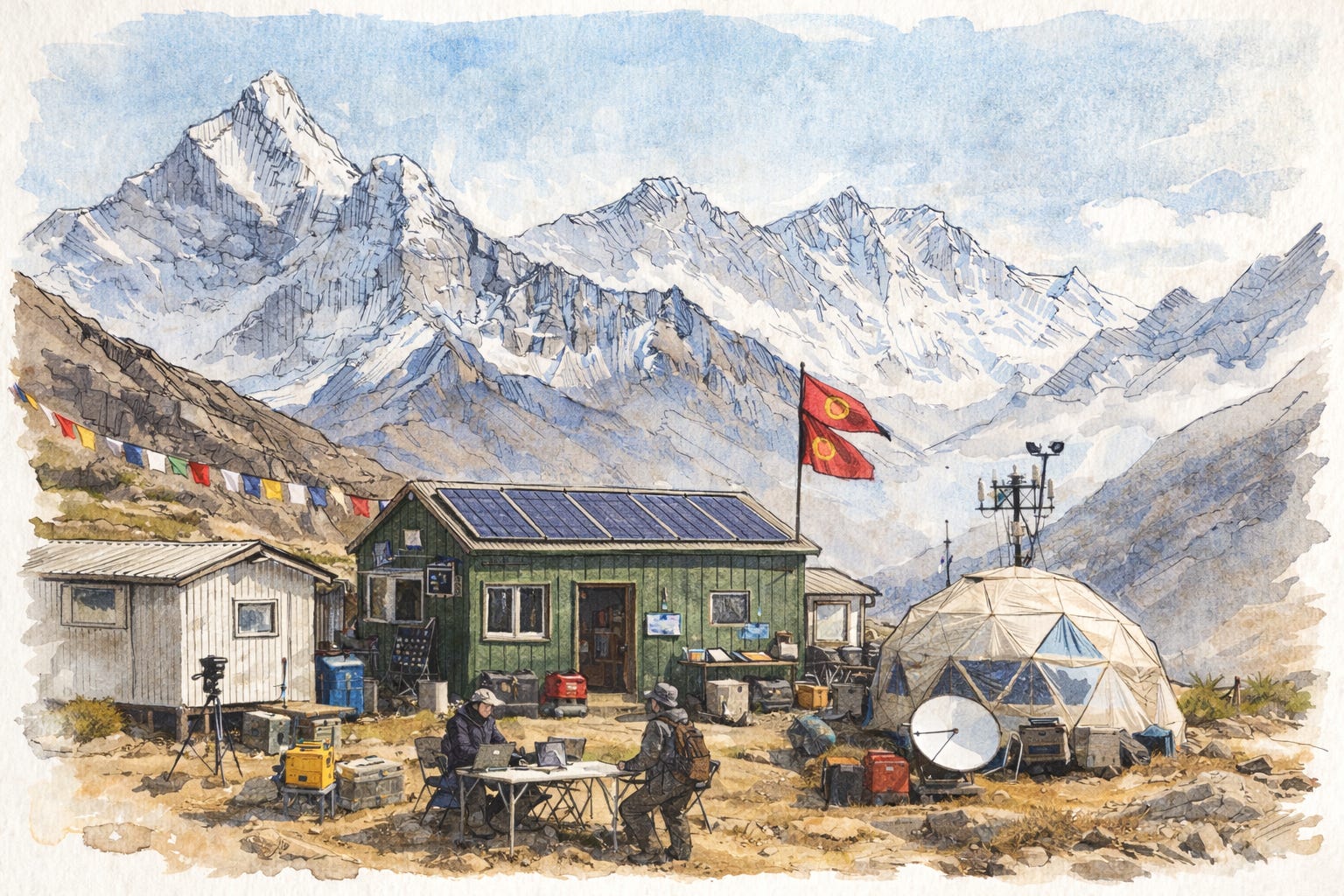
Concept art for a future Hawke Systems Nomad use case.
The carry-on suitcase acts as a kind of rolling base camp. I use a Rimowa Cabin S, which is admittedly overkill. However, my carry-on becomes the chassis for everything else I travel with. If the wheels fail, the latches breaks, or the frame collapses, it can ruin an entire trip faster than almost anything else. Rimowa’s engineering and global service network make it the Toyota Land Cruiser of luggage, at least to me. And I’m nothing if not a Toyota Land Cruiser fan.
Inside are Peak Design ultralight packing cubes for clothes and toiletries, and a tech pouch that functions as redundancy: additional power, a Skross global adapter, a backup phone, basic first aid and laundry, and an analog emergency pouch. This last pouch is one that I never touch unless things go sideways.
And eventually, they will.
Failure Modes
These are all actual things that have happened to me or during my travel:
A colleague once connected to a random WiFi network at a bar in Hong Kong and had his phone compromised.
Friends and colleagues have occasionally had phones unlocked and searched when crossing borders.
Hotel WiFi in China has dropped important calls for me every single week I visit.
A friend left his backpack containing his passport in a random car we paid cash to drive us through rural China.
Another broke his only phone halfway through the same trip.
I left my phone in an Uber in Hong Kong. Similarly, a friend left her phone and wallet in a Grab car on her first day in Vietnam.
An eSIM has failed to activate when crossing a border.
A bank has frozen a debit card while traveling.
A hostel power outlet wouldn’t accept any adapter I brought with me.
A flight was delayed and the airline-comped hotel had a 3-hour entry queue at 1 AM.
Nothing here is catastrophic on its own, but they compound quickly.
A dead phone can mean no payments. No payments means no transport. No transport means missing a meeting or flight and one long walk in a tropical climate. Modern travel is extremely convenient, but when it fails, you feel it quickly.
After enough of these experiences I started wondering whether there was a missing piece in my setup. I had redundancy for power, backup phones, multiple payment systems, and offline copies of important documents.
Power is usually abundant, but money is meaningless if you can’t access it. What lies in between is network connectivity, and I was still relying on others for that. The upshot: more often than not, networks are the breaking point.
This realization led to a simple idea:
What if I could carry a small device that acted as my own portable infrastructure, a personal network, encrypted storage, and a secure connection that traveled with me anywhere in the world?
That question is what eventually became the Nomad Mk I pocket infrastructure node. And that’s where this project begins.
I’m building it as an experiment, a phone-sized device that creates its own network, storage, and secure connection wherever it goes.
In the next post in this series, I’ll explain what the device actually does, why I chose to build the prototype around a Raspberry Pi platform, and whether there’s a real market for something like this.
