


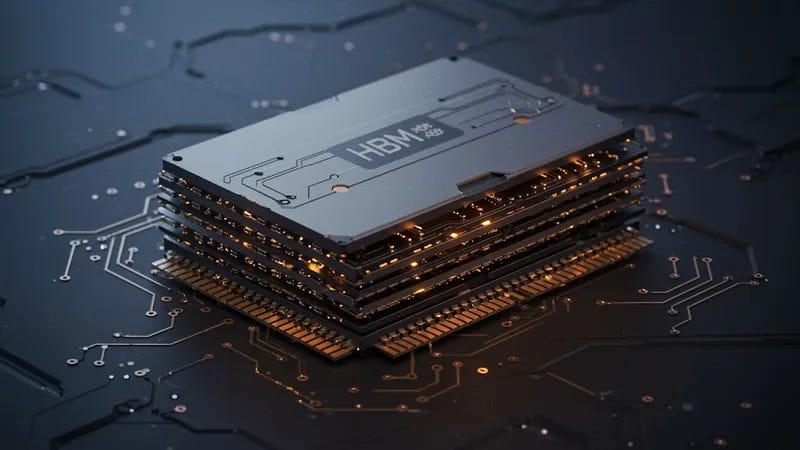
High-bandwidth memory (HBM) chip, a big focal point of 2025. Source: Wevolver.com
Electronics is no longer a single industry. It’s a stack of interdependent bottlenecks, shaped as much by geopolitics and industrial policy as by Moore’s Law, and actively scaling with the size and shape of the global economy. In 2025, that reality became unavoidable. The global electronics market continued to grow, but the story of the year wasn’t volume, it was constraint. Power, memory, packaging, export controls, and capital allocation quietly determined who mattered and who didn’t.
Recap of 2025
By most estimates, the global semiconductor market finished 2025 somewhere just north of $700 billion, depending on who you ask and how they count. That number matters less than where the profits pooled. AI infrastructure pulled capital and talent upstream, while large swaths of consumer electronics remained soft. The result was an industry that looked healthy in aggregate but deeply uneven underneath.
If the $700B figure surprises you, you’re not alone. Semiconductors are volumetrically a smaller industry than most expect, and their impact pertains more to being a bottleneck for other industries. Their competitive landscape, similarly, is shaped less by purely money and more by a blend of coordination, specialization, and deep expertise over decades- which is why it’s been so hard for new entrants to succeed, let alone gain dominance.
Events that Shaped the Year
If there was one reminder in 2025 that “boring chips” are no longer boring, it was Nexperia. What should have been a routine story about analog and discrete components instead became a lesson in how geopolitics now reaches deep into ownership structures, packaging lines, and export permissions. The takeaway wasn’t about one company, it was that mid-stack semiconductors are now strategic assets by default, whether executives like it or not, and more bluntly, that China is willing to use this class of chip as leverage in economic negotiation. This will force trading partners to reassess exposure and contingency planning.
2025 also clarified that memory, particularly HBM (high bandwidth memory), is no longer a supporting actor. It is the plot. As AI training and inference workloads scaled, memory bandwidth and yield became the pacing constraint, not compute. HBM became a critical input that feeds data into NVIDIA (and other) GPUs, which provide parallel-path computing that drives AI development. The industry spent the year reorganizing itself around this reality, with capital, roadmap priority, and customer relationships flowing toward whoever could ship reliably at scale.
Finally, 2025 closed with a subtle but important shift in tone. For the first time, credible forecasts began treating a trillion-dollar semiconductor market as plausible rather than aspirational. That number matters less as a target than as a mindset, it changes how governments plan subsidies, how suppliers justify capacity, and how executives think about risk.
It’s worth noting that the 2025 semiconductor market likely looked very different to different companies depending on their specific market and product categories. Most consumer electronic manufacturers likely dealt with symptoms of component excess due to oversupply of trailing-edge nodes, commodity logic chips, and generally consumer-oriented chips, and relatively lower demand. By stark contrast, AI-related memory chips, components requiring advanced packaging, and power chips all remained quite constrained due to growth around AI.
Winners and Losers
The winners of 2025 were unsurprising in hindsight. Companies exposed to AI infrastructure, advanced memory, substrates, and packaging captured outsized value. The losers weren’t necessarily poorly run, they were simply tied to slower replacement cycles or exposed to regulatory friction. In this environment, neutrality is no longer safe.
Winners
SK Hynix - The big surprise winner of 2025 was South Korea’s SK Hynix, who committed to the high-bandwidth memory trend early, gambling that AI needs would outpace consumer memory demand. They now own over 50% of the HBM market.
2025 market cap growth (USD): from $90B to $300B (+$210B)
Micron - The story here is much the same. Micron made the pivot a bit later, but surpassed Samsung Electronics in 2025 to become the second largest HBM player (21% market share).
2025 market cap growth (USD): from $94B to $320B (+$226B)
NVIDIA - If it feels obvious to include them here… that’s why they made the list. The greatest success story of the post-COVID era, NVIDIA has essentially reshaped the industry. Their parallel-compute GPUs have extreme memory needs- most of this is driven by demand from AI LLM developers. In this sense, SK Hynix, Micron, TSMC, and ASML are all critical partners, but are increasingly shaped by NVIDIA’s requirements.
2025 market cap growth (USD): from $3.4T to $4.6T (+$1.2T)
TSMC - The Taiwanese giant is another obvious choice as they’ve become a byword for the pure-play foundry model and frankly the semiconductor industry itself. They have worked around strategic vulnerabilities and constructed a large-scale fab in Arizona, remaining an industry cornerstone for the foreseeable future.
2025 market cap growth (USD): from $1.2T to $1.7T (+$500B)
ASML - The most upstream firm on the list and another slam-dunk annual winner. ASML got a lot of press in 2025. As light was shone on the industry and its many bottlenecks, none was more evident than that created by ASML, whose EUV machines will continue to define this era of chips.
2025 market cap growth (USD): from ~$350B to $500B (+~$150B)
Note: I’m using market cap here not as a single metric to capture total performance, but as a proxy for where investors believe durable leverage lives as of Jan 2026.
Losers
In an industry that is experiencing hyper-growth, it’s hard to call anyone a loser. “Losing” in semiconductors in 2025 looks more like flat growth, lack of execution on a consistent vision, waning brand power, or an inability to capitalize on trends. For this reason, I won’t name many names- we’re not picking stocks here.
Intel is perhaps the best example. They’re notably in a challenging position, offering foundry services to compete with TSMC while also competing with their customers by building their own internally-designed chips. This has created very public market challenges. In the past 5-10 years, they’ve lost the lead in process and look to recapture this technical capability while also reorganizing strategically. If they were the Detroit Lions, we’d call it a rebuilding year. A longer horizon will be fairer to them.
GlobalFoundries is a good parallel example. A pure-play foundry and once closer in ambition to TSMC, they’ve intentionally focused on trailing-edge and specialty nodes and not compete in the extremely capital-intense leading-edge. As demand softened and excess inventory crept up in consumer-tier chips, companies like GlobalFoundries were impacted in an outsized way.
Expectations for 2026
I’m not especially good at short-term prediction- it’s just not in my wheelhouse, and I find that most forecasts end up being fairly incorrect. Instead of forecasts, let’s look at broad constraints and trends. For 2026, three forces look likely to shape outcomes regardless of how individual products perform.
First, high-bandwidth memory will continue to behave like a strategic commodity. Supply will improve, but qualification, yield, and packaging capacity will keep it scarce enough to confer leverage. This will ripple outward into substrates, foundry allocation, and even data center design. Packaging may in particular end up being a particular vulnerability if new OSATs need to be opened. While these used to be lower-margin and cost-sensitive, they’re now complex differentiators. Geopolitics may become a bigger factor in site choice.
Second, portfolio triage will accelerate. Micron’s shift away from low-margin consumer lines toward data center and AI workloads isn’t an anomaly, it’s a preview. In 2026, more companies will quietly abandon legacy businesses that no longer justify capital or engineering attention. As we saw this year (Nexperia), these consumer lines can be massively critical if generally less newsworthy. I predict that the industry will continue to bifurcate into two classes of firms- leaders will play in the capital-intensive space that serves AI, government-backed projects, and aerospace/defense, and the gap between these and dedicated consumer-oriented manufacturers will solidify.
Third, industrial policy stops being a backdrop and becomes the weather. Tariffs, subsidies, localization rules, and security reviews won’t fade, they’ll harden. Electronics supply chains in 2026 will be designed assuming friction, not efficiency. There’s a lot that can be said around this, but in general, dual-sourcing becomes the bare minimum for survival. Companies that don’t have the SCM resources to deal with this will outsource their strategic vulnerabilities to firms that offer constant analysis, safety stock, and even development and kitting.
That’s a Wrap
This piece is less about predicting winners and losers or even specific trends. It’s inevitable that we take our current position each year and basically project it into the future with no knowledge of disruptions.
I’d like this to become an annual tradition that forms a baseline against which all my other thoughts will be weighed. What’s become clear is that semiconductors are the engine, but they’re hardly the only fascinating topic. In 2026, I’ll wade into frontier tech, hard tech, and the confluence of a lot of factors that shape these industries.
By the end of this year, we’ll have discussed rockets, rare earth minerals, and wearable tech, and my next State of the Industry will be all the richer for it.

Hey, great read as always, your take on AI centralising capital is astute, though I also see the talent pipeline becoming a cruciall bottleneck.