


MYTH
Americans won’t work in heavy industry.
The more accurate myth is not that Americans don’t want to work in factories, it’s that Americans won’t tolerate productive discomfort. This belief is usually delivered with a shrug, as if it were some immutable cultural flaw, proof that the country has simply “moved on.” It’s convenient, comforting (for some), and mostly wrong.
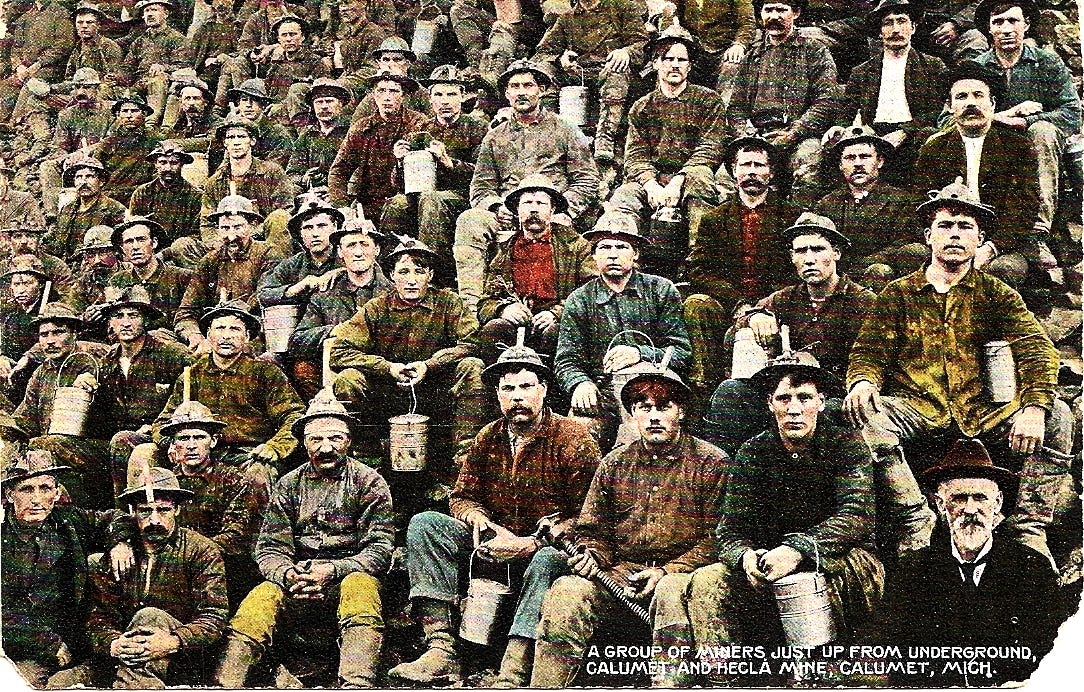
Americans will tolerate difficult, repetitive, physically demanding work when the trade is honest. They always have. They did it in mines, mills, foundries, auto plants, shipyards, and machine shops for generations. What they will not tolerate is work that feels extractive, stagnant, and designed to disappear. This distinction matters. Americans, like all humans, weigh their options and take the best path that optimizes for long and short-term income, comfort, agency, and flexibility.
Stating that Americans don’t want to work in factories without acknowledging that Americans will always choose more comfortable office work if the two pay the same is just silly. The collapse of American factory employment was not a mass cultural refusal to work with one’s hands, it was a rational response to jobs that increasingly offered low pay, low dignity, little progression, and no future— and which were increasingly outsourced.
The deeper truth is that Americans were never really given a choice. Manufacturing didn’t hollow out because workers opted out en masse, it hollowed out because capital opted out first. Production was moved offshore at scale essentially in pursuit of margin protection. Entire ecosystems of skills, suppliers, and institutional knowledge were treated as interchangeable inputs, not strategic assets. When plants closed, workers didn’t “choose” service jobs because they preferred them, they took what was left. Companies optimized for shareholder value, and that was that.
None of this is uniquely American. The same pattern played out simultaneously across Europe, and we are watching it unfold in real time in China. Young Chinese workers, when given alternatives, are leaving factory floors just as American workers did a generation earlier. Manufacturing is being pushed further down the cost curve into Southeast Asia, while China races to automate and move up the value chain. Even the much-discussed 996 culture is less a cultural preference than a transitional phase, tolerated because options are constrained, not because it is desirable.
This is the uncomfortable implication of the myth. People everywhere respond similarly to incentives, dignity, and opportunity. Americans were not uniquely lazy, Chinese workers are not uniquely industrious, and factory work is not uniquely unattractive. What differs is whether a society treats production as a dead end to be minimized, or as a strategic function worth investing in.
MYTHOS
Industry is citizenship.
Long before it was an economic category, industry was a form of belonging. In the American imagination, to make things was not merely to earn a wage, it was to participate in the project. Detroit didn’t just assemble cars, it assembled mobility, scale, and modern life. Pittsburgh steel wasn’t just material, it was the skeleton of a rising power. Milwaukee’s machine shops, Superiorland’s iron and copper, Texas oil, California’s peculiar fusion of invention and production, these were not disconnected episodes. They were regional expressions of a shared belief that building tangible systems mattered, and that doing so anchored a nation in reality.
This is what often gets lost when manufacturing is reduced to a spreadsheet problem. Industry shapes rhythms, identities, and expectations. It dictates how towns grow, how skills are passed down, how people understand their place in the world. Culture follows production more often than we like to admit. Music, language, humor, even politics bend around what a society spends its days doing. When you remove the act of making from daily life, you don’t just change the economy, you thin out the culture.
It’s worth comparing the culture that arises under such circumstances. Anecdotally, the difference between old-school smelter workers in Cudahy, Wisconsin or Saginaw, Michigan and modern electronics or textile factory workers in Saigon or Guangdong is much less significant than the difference between either of them and modern service/tech employees essentially anywhere in the US. Making physical products changes us.
Anyone who has spent time in Asia’s new industrial heartlands can feel this immediately. There is a gravity there, a sense of forward motion and shared effort that is difficult to fake. It is not romantic, and it is not gentle, but it is real. Cities are oriented around output. Skills compound quickly. Young people see pathways, not just jobs. What is striking is not that this energy exists there, but how recently it existed in the West, and how quickly it moved.
America has not lost this entirely. Pockets of it remain, in advanced manufacturing, in defense, in semiconductors, in specialized machine work and key verticals. But the mythos has weakened. Production is no longer treated as a civic act, something that confers dignity and responsibility, but as a temporary necessity to be optimized away. That shift did not just hollow out factories, it hollowed out a shared sense of contribution.
The danger is not that America forgot how to make things. It’s that it began to forget why making things mattered at all.
The Path Forward is Physical
Offshoring and the pivot toward a data and service economy have not been uniformly bad for Americans as individual workers. In many cases, compensation rose. Work became cleaner, safer, more flexible. The average white-collar professional gained comfort, mobility, and optionality that would have been unimaginable in the mid-20th century. It would be dishonest to deny that.
But what worked for some individuals did not work cleanly for the nation.
The strategic cost of offshoring was not simply lost jobs, it was lost leverage. As Chris Miller has argued, manufacturing matters less because it employs large numbers of people, and more because it anchors power. Production determines who controls supply chains, who sets standards, who learns fastest, and who can respond when systems are stressed. When manufacturing leaves, those capabilities leave with it, quietly at first, then all at once. It’s remarkable how fast this happens— the average working life is about 40-50 years. A shift can happen in half that time.
This is why the consequences only become obvious during crises. Pandemics, wars, trade shocks, and technological inflection points expose the fragility of an economy that consumes far more than it produces. A country that no longer builds at scale must negotiate from dependence rather than strength, no matter how sophisticated its financial markets or software ecosystems may be.
The answer is not autarky, and it is not nostalgia. It is a deliberate rebalancing toward physical capability. That means deeper vertical integration in strategically sensitive areas, especially upstream processing of materials and components where external choke points are most dangerous. It means aggressive automation, not as a substitute for labor, but as a force multiplier that collapses cost advantages and accelerates learning. And it means rebuilding credibility around production as a career, with clear advancement paths, technical prestige, and tangible upside for the people who make complex systems work.
It’s worth asking whether the US can survive if we’re bifurcated into venture capitalists and baristas. An exaggeration, but rooted in uncomfortable truth. An economy without a broad, skilled, productive middle is not just unequal, it is unstable, and frankly upstream of a lot of other challenges we see today and that could worsen in the future.
The path forward is not purely digital. It is physical, embodied, and grounded in the act of making. Without that, prosperity becomes thinner, power becomes borrowed, and culture itself begins to drift.
Addendum
The US seems to be jointly and apolitically waking up to the reality that we need to make things. The growth of hard tech in the US cannot be overstated- firms like NVIDIA, Tesla, SpaceX, Apple, Anduril, and countless others have led the way.
This all points to less of a manufacturing resurgence, certainly not one led by tariffs, but more of an acknowledgement of strategic shortcomings and subsequent realignment. I expect a lot of ebb and flow and discussion around manufacturing— but it’s increasingly back in the conversation, for now.
A few bright spots and complications in this next phase of the journey:
Intel’s Silicon Heartland initiative involves the construction of a new semiconductor fab in New Albany, Ohio, targeting 2030 for completion (after experiencing delays). There are reportedly challenges in identifying customers for these chips, likely in part due to a premium on manufacturing costs. Similar challenges have been reported with TSMC’s new Arizona fab (10% cost increase vs Taiwan).
Andreesen Horowitz’s American Dynamism practice is funding civic-minded founders with visions to improve our national defense and infrastructure.
Semiconductor manufacturing growth in the US has created the need for 300,000 trained employees by 2030.
