


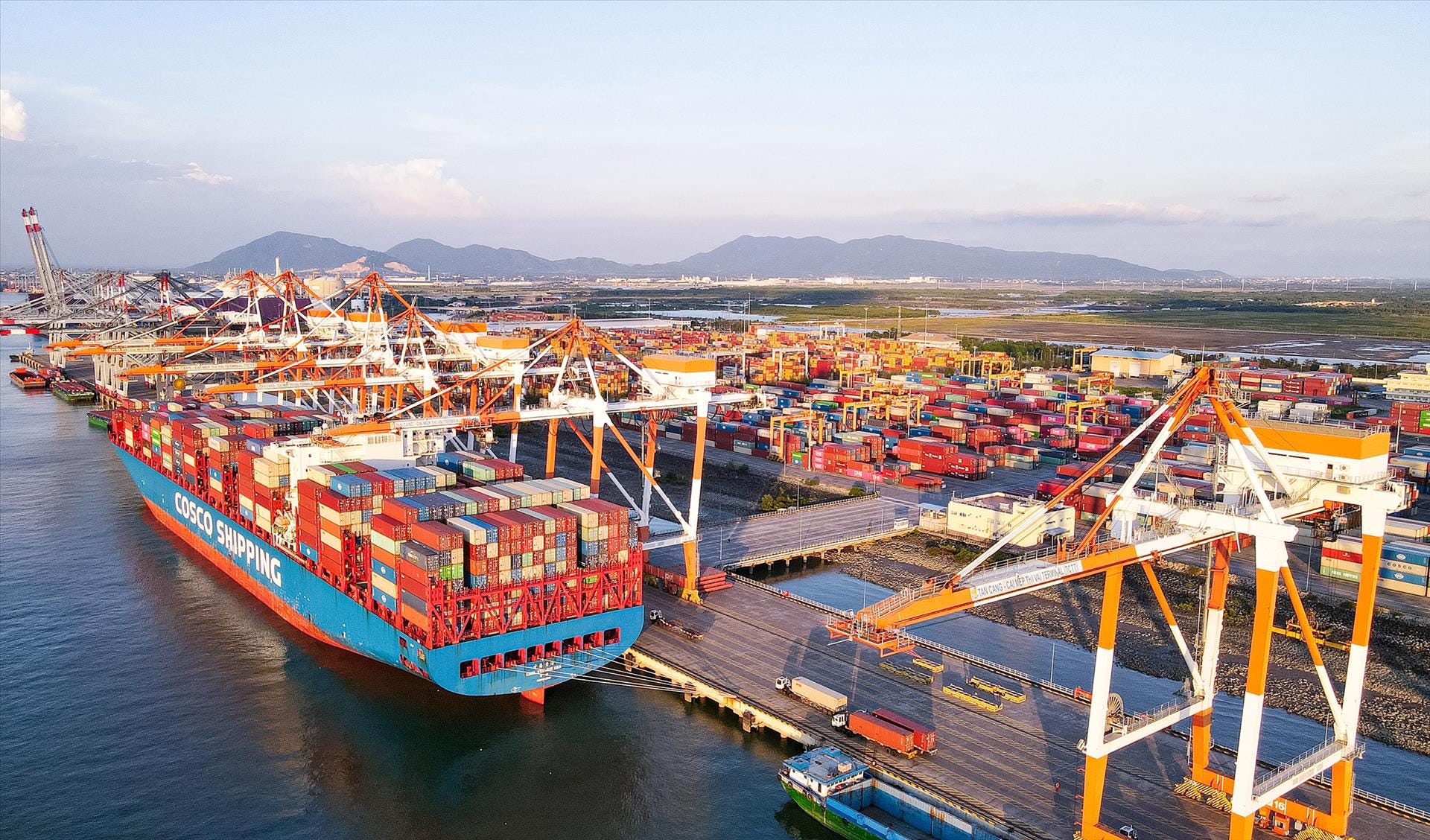
Cai Mep-Thi Vai Port. Source: Vietnam Pictorial
It’s clear to any visitor that Vietnam is defined as much by its future as by its past. As soon as I touched down from Hong Kong to Saigon’s central Tan Son Nhat Airport, I hopped in a Grab and was taken through the land of smiling Tiger Beer ads, a continuous but pleasantly humming stream of motorbikes, and nods to the modern country’s founder.
Hong Kong is not a pessimistic place, but Ho Chi Minh City felt distinctly warmer and more youthful by comparison. I could wax poetic about the egg coffees and French-era architecture, but instead, I’m here to talk about the evolution of the city and country more broadly, and that became apparent only on the latter half of my stay, traveling 4-6 hours a day for factory visits. I’ve seen a fair cross section of Asia, and Vietnam firmly falls somewhere “in-between”, but to the surprise of no one, growing quickly.
In the industrial zones outside Ho Chi Minh City, half-built factories line the highways beside billboards for Samsung and Foxconn. There’s an unmistakable hum of progress here: trucks carrying reels of copper, workers on scooters wearing matching company vests, and the steady rhythm of construction cranes edging toward the skyline. Vietnam feels like a country in motion, but it’s also one learning to manage the growing pains that come with that speed.
As it unfolds, there are some serious challenges ahead, but Vietnam is already well into its play to become an electronics manufacturing powerhouse, and it hinges on one key factor.
Bigger Picture
Governed by the Communist Party of Vietnam since 1975, the country enjoys a stability and uniform directionality that few others regionally can boast (excepting China). It’s likely for that reason that they’ve seen such intentional investment in an export economy as companies and countries broadly explore a China+1 strategy. Vietnam forms a solid analog to China, with a young and well-positioned workforce, ports, and a willingness to bring business in.
As of time of writing, the country has a population of just under 102 million people (growing at 0.6% annually), with Ho Chi Minh and Hanoi each containing 20 million people in their metros. GDP sits at $476B USD (7.1% annual growth rate).
That growth is built on decades of gradual reform. In the 1990s and 2000s, Vietnam’s economy was powered by textiles and footwear, its labor advantage attracting companies like Nike and Adidas. In recent years, those same industrial parks have pivoted toward electronics. Where once stood garment lines, now stand cleanrooms assembling smartphones and circuit boards.
Foreign direct investment (FDI) topped $36 billion in 2023, with South Korea, Japan, and Singapore leading the charge. China, once viewed primarily as a rival, is now a complex partner, investing in logistics and energy projects even as companies relocate manufacturing out of it. For multinationals, Vietnam has become the defining hedge in a world that no longer tolerates single-source dependency.
Bottleneck
Despite its momentum, Vietnam’s next leap forward hinges on something deceptively simple: infrastructure.
While industrial parks have sprung up across the southern provinces, moving goods between them remains painfully slow. The 1,600 km stretch from Hanoi to Ho Chi Minh City lacks a unified high-speed corridor, and the country’s logistics costs remain around 16-17% of GDP, significantly higher than regional and global competitors.
There are several huge bright spots:
North–South Expressway: This will connect Vietnam, from Lang Son on the Chinese border to Ca Mau on the Gulf of Thailand.
Long Thanh International Airport: Expected to open in 2026 as Saigon’s new international airport (Tan Son Nhat will revert to domestic-only).
Expanded deepwater ports at Cai Mep–Thi Vai: The major port near Saigon has been upgraded to Vietnam’s largest international transshipment port.
Ho Chi Minh City Metro: Launched in December 2024 with 1 line, 650 km total rail planned.
These projects will be transformative, but they’re running against the clock. Each delay keeps lead times high and dulls the country’s competitive edge.
Vietnam’s infrastructure paradox is that its industrial growth outpaces the physical means to sustain it. Trucks queue for hours outside ports; container traffic competes with everyday commuters; power outages, while less frequent than a decade ago, still threaten production schedules. Even within Ho Chi Minh City, metro construction has stretched into its second decade, a reminder that the path from ambition to reality can be uneven.
The government has launched the “National Logistics Action Plan,” which achieved its target to cut logistics costs to 16% of GDP by 2025. New expressways are linking industrial corridors from Binh Duong to Dong Nai, and Long Thanh Airport, when completed, will handle up to 100 million passengers and five million tons of cargo per year. If Vietnam can align its infrastructure push with its manufacturing boom, it could create a feedback loop of investment and capability rarely seen outside East Asia’s great economic miracles.
Implications for Electronics
Vietnam’s electronics boom will depend on whether its supply chain can match its enthusiasm. Assembly operations are growing fast, but most critical components, such as semiconductors, sensors, and PCBs, still flow through China, Taiwan, or South Korea.
Until local suppliers scale up and logistics efficiency improves, Vietnam will serve as an assembly hub rather than a manufacturing ecosystem, essentially a new way station in an already complex system.
This distinction matters. Assembling smartphones or laptops is labor-intensive but low-margin. The true economic power lies in the upstream stages: chip fabrication, component production, and design. Today, those remain concentrated in economies with deep capital markets, skilled engineers, and research infrastructure. Vietnam’s advantage lies in execution, not invention, at least for now.
That said, the government’s partnerships with Intel, Samsung, and Amkor, plus tax incentives for component production, signal a push to move up the value chain. The country’s success may rest on whether its roads, ports, and policies can connect its newfound ambition with reliable execution.
To climb further, Vietnam will need more than factories- it will need engineers, data infrastructure, and trusted trade policy. The country has launched dozens of technical training programs and partnerships with Korean and Japanese firms to upskill its workforce. If successful, this could replicate the South Korean model of state-guided industrial learning. If not, Vietnam risks being trapped in the assembly tier as automation erodes its cost advantage.
Upshot
Vietnam stands at a familiar crossroads: a country on the verge of greatness but bound by the limits of its roads and runways. The optimism is pragmatic. Every kilometer of new highway or fiber-optic cable expands the country’s ability to participate in the digital economy. Every partnership inked with a multinational teaches local managers how to compete on a global stage. Progress here is incremental, not explosive, but it’s unmistakably forward.
I’m high on Vietnam. The country feels noticeably vibrant and full of optimism in a way that most are not, in 2025. It’s unusual that a pivot to higher-tech manufacturing would require solving problems that by comparison are relatively lower-tech or that have already been solved elsewhere, but I view that as encouraging. The incentives are aligned and initiatives are underway, and I think this is just the beginning.
The egg coffees can stay, but I’m looking forward to eliminating the 2-hour commutes.
